Why Cybersecurity Is a Business Priority
In today’s digital economy, cybersecurity is no longer just an IT concern – it is a critical business responsibility. Companies rely heavily on digital systems for communication, transactions, data storage, and daily operations. While this digital transformation enables growth and efficiency, it also exposes businesses to a growing range of cyber threats.
Cybercriminals continuously develop new techniques to exploit system vulnerabilities, steal data, and disrupt operations. According to cybersecurity research, cybercrime damages are projected to reach $10.5 trillion annually, making it one of the most significant global economic threats.
From small startups to multinational enterprises, no organization is immune to cyber attacks. Understanding the cyber threats businesses face today is the first step toward building stronger security defenses and protecting sensitive information.
Why Cyber Threats Are Increasing?
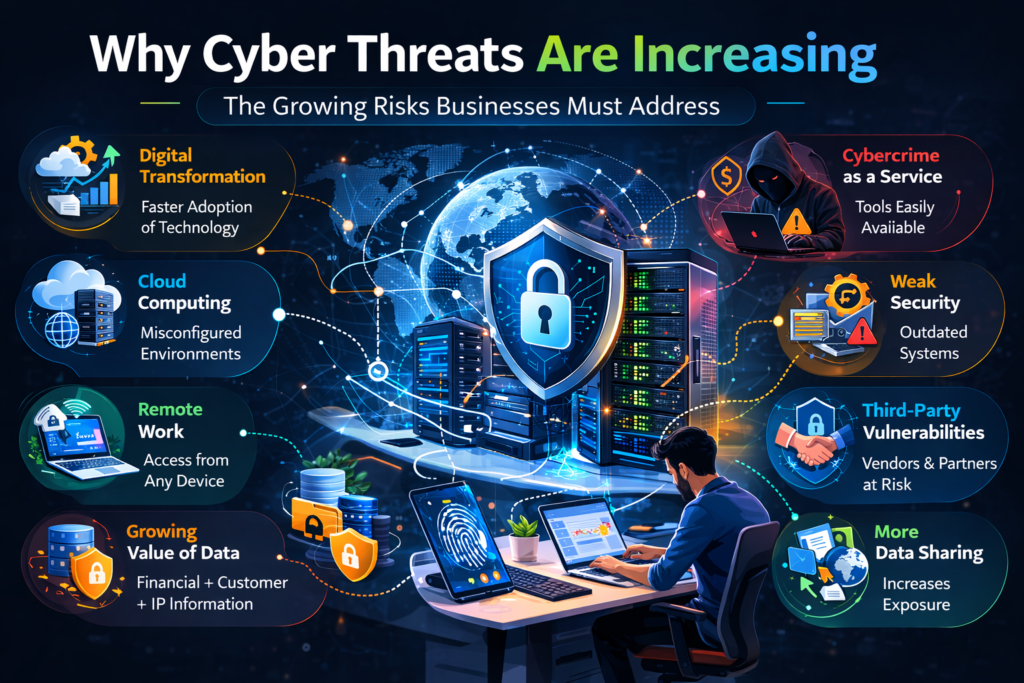
Several major trends have contributed to the rapid rise in cybersecurity threats.
Digital Transformation
Businesses are adopting digital technologies faster than ever before. Unfortunately, security frameworks sometimes fail to keep pace with this rapid transformation.
Cloud Computing Growth
Cloud platforms provide flexibility and scalability, but misconfigured cloud environments remain one of the leading causes of modern data breaches.
Remote Work Environments
Remote work allows employees to access business systems from various locations and devices. Home networks and personal devices often lack enterprise-level security.
Cybercrime-as-a-Service
Advanced hacking tools are now widely available on underground markets. Even attackers with limited technical skills can launch sophisticated cyber attacks.
Growing Value of Data
Businesses store enormous volumes of sensitive information, including financial data, customer records, and intellectual property. This makes organizations attractive targets for cybercriminals.
Top 10 Cyber Threats Businesses Face Today
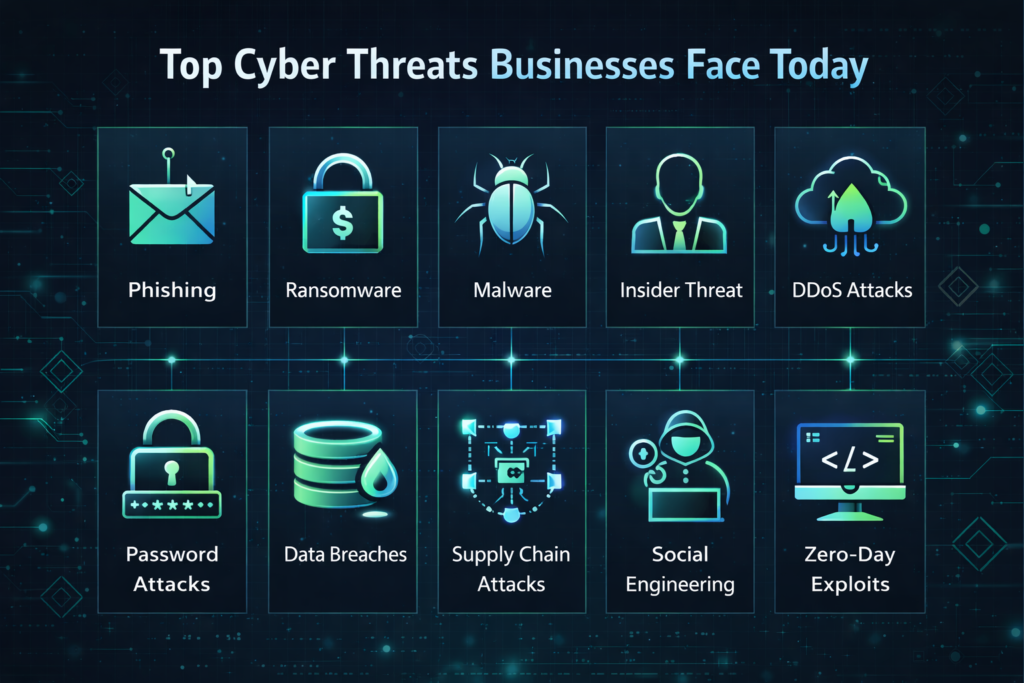
1. Phishing Attacks
Phishing continues to be one of the primary methods cybercriminals use to gain unauthorized access to systems. Attackers send fraudulent emails or messages impersonating trusted organizations or colleagues.
The goal is to trick employees into clicking malicious links, downloading infected files, or revealing login credentials.
Prevention Tip:
Provide employee security training and use advanced email filtering systems.
2. Ransomware Attacks
Ransomware attacks are considered one of the most damaging types of cyber threats. Attackers infiltrate company networks, encrypt important data, and demand payment in exchange for restoring access.
These attacks can completely halt business operations.
Prevention Tip:
Maintain secure offline backups and deploy endpoint detection systems.
3. Malware Attacks
Malware is a type of harmful software created to disrupt systems or steal sensitive data.
Option 2: It includes viruses, trojans, spyware, and worms.
Malware often spreads through infected downloads, malicious websites, or phishing emails.
Prevention Tip:
Install updated antivirus software and restrict unauthorized application installations.
4. Insider Threats
Insider threats occur when employees or business partners misuse their access privileges.
This may be intentional, such as data theft, or accidental, such as exposing sensitive information.
Prevention Tip:
Apply the principle of least privilege and regularly review user access permissions.
5. Distributed Denial-of-Service (DDoS) Attacks
In a DDoS attack, cybercriminals overwhelm a company’s servers with massive traffic, making services unavailable.
For online businesses, even a few hours of downtime can result in major financial losses.
Prevention Tip:
Use DDoS protection services and content delivery networks (CDNs).
6. Password Attacks
Weak passwords are a major security vulnerability. Attackers often use techniques such as:
Brute-force attacks
Credential stuffing
Dictionary attacks
These methods allow hackers to gain unauthorized access to systems.
Prevention Tip:
Use strong password policies and activate multi-factor authentication (MFA) to improve account security.
7. Data Breaches
A data breach happens when unauthorized parties obtain access to sensitive or private information.
This can include customer data, financial records, or intellectual property.
The average cost of a data breach globally now exceeds $4 million, making it one of the most expensive cyber incidents businesses face.
Prevention Tip:
Encrypt sensitive data and conduct regular vulnerability assessments.
8. Supply Chain Attacks
Today’s organizations depend greatly on third-party vendors and external service providers. Attackers may target these partners to gain access to their clients.
One well-known example is the SolarWinds supply chain attack, which compromised thousands of organizations through a trusted software update.
Prevention Tip:
Evaluate vendor cybersecurity practices and restrict third-party system access.
9. Social Engineering Attacks
Most organizations depend on third-party companies to manage certain services and operations.
Attackers manipulate employees into revealing confidential information or performing actions that compromise security.
Common tactics include impersonating executives, fake support calls, or fraudulent payment requests.
Prevention Tip:
Conduct regular cybersecurity awareness training.
10. Zero-Day Exploits
Zero-day vulnerabilities are software flaws unknown to developers at the time of discovery.
Because no patch exists yet, attackers can exploit these vulnerabilities before organizations have a chance to fix them.
Prevention Tip:
Apply security updates quickly and deploy behavior-based threat detection systems.
Real-World Impact of Cyber Attacks on Businesses
Cyber attacks can have devastating consequences for organizations.
Financial Loss
Companies may face ransom payments, recovery expenses, legal fees, and lost revenue during downtime.
Reputational Damage
Customers lose trust in organizations that fail to protect their data.
Operational Disruption
Ransomware or DDoS attacks can halt business operations entirely.
Legal and Regulatory Penalties
Regulations such as GDPR impose severe fines for failing to protect sensitive information.
How Businesses Can Protect Themselves
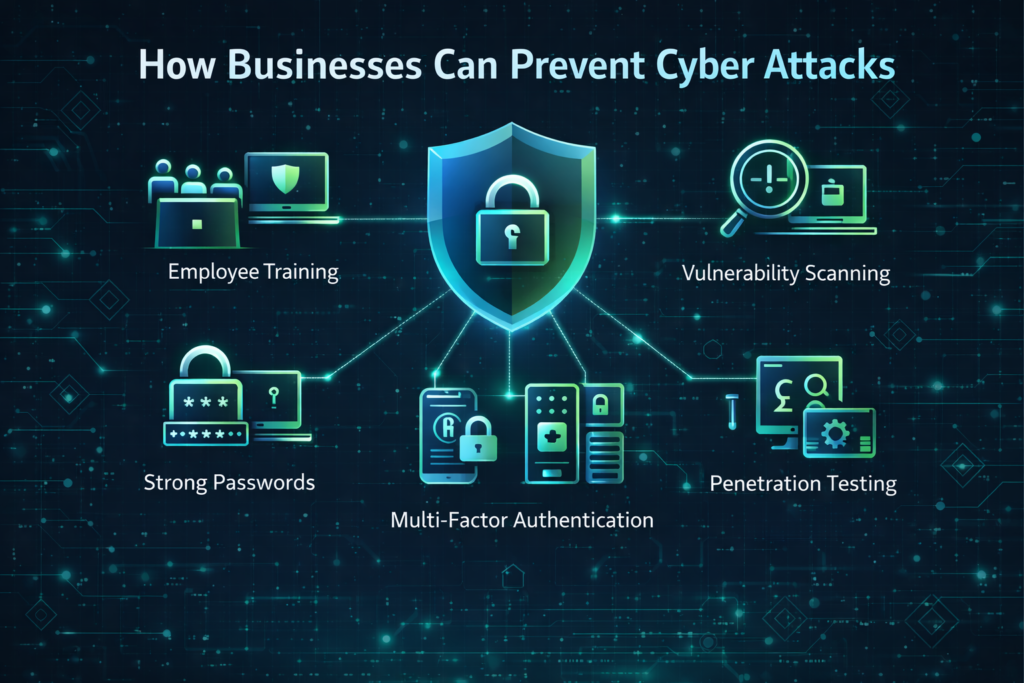
Organizations should implement a layered cybersecurity strategy that includes:
- Employee cybersecurity awareness training
- Strong password policies
- Multi-factor authentication (MFA)
- Regular vulnerability assessments
- Penetration testing
- Continuous network monitoring
- Software updates and patch management
A proactive security strategy allows businesses to detect vulnerabilities early and prevent serious cyber attacks.
Conclusion
Cyber threats are constantly evolving as businesses become more digitally connected. From phishing and ransomware to insider threats and zero-day vulnerabilities, organizations must stay vigilant against a wide range of security risks.
Cybersecurity is not a one-time project but an ongoing process that involves technology, employee awareness, and proactive monitoring. By understanding the most common cyber threats businesses face and implementing strong security practices, organizations can significantly reduce their risk.
In today’s digital world, protecting your business from cyber threats is not optional – it is essential for long-term success.
